


When choosing a sex doll, many buyers first ask whether she can sit, stand, or kneel. These questions tell you something about the skeleton’s range of motion, but they don’t tell the whole story. How easily can you adjust the joints? Will the doll hold a pose once you’ve positioned her? And how well will the skeleton perform after repeated use?
A good skeleton needs to balance flexibility with support. The joints should move smoothly without requiring excessive force, while providing enough resistance to keep the doll in a natural position.
Today, sex dolls come with different skeleton options, including Standard, EVO, and EXP designs, along with various joint tightness settings. More joints and a wider range of motion may sound appealing, but they don’t automatically make a skeleton better for everyday use.
This guide explains what to look for in a sex doll skeleton, how different designs compare, and which upgrades are worth considering based on how you plan to use your doll.
What Makes a Good Sex Doll Skeleton?
Most full-body TPE and silicone sex dolls have an internal metal skeleton that supports their weight and allows you to adjust their posture. Joints in the shoulders, elbows, waist, hips, and knees control most of the body’s movement.
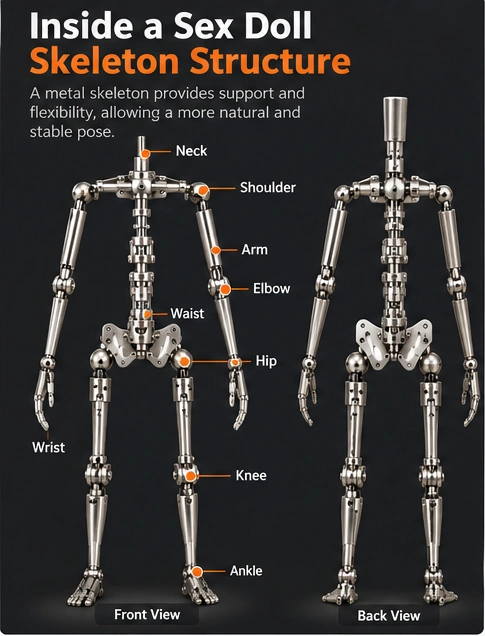
When comparing skeletons, focus on four important details.
1. Can the Joints Move Naturally?
A skeleton’s range of motion determines which poses a doll can achieve. However, not all skeletons move in the same way.
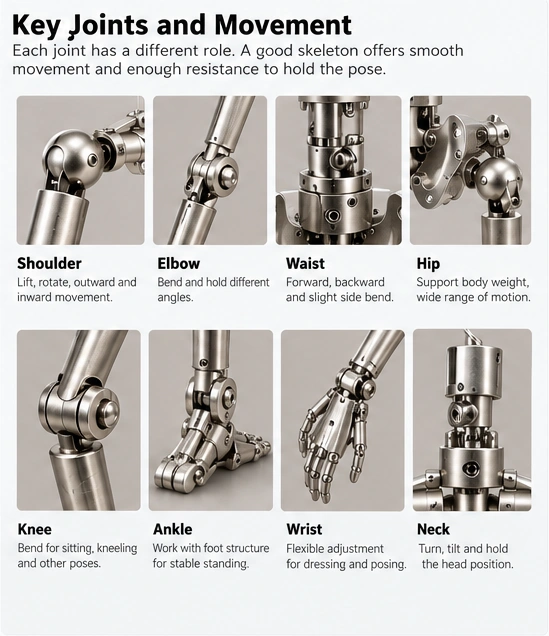
Take the shoulders, for example. A standard skeleton generally allows the arms to move up, down, and outward. Some upgraded skeletons include movable shoulder structures that allow limited shrugging or inward shoulder movement.
The same applies to the waist and knees. More advanced joint designs may allow deeper knee bends, more natural sitting positions, or additional upper-body movement.
However, the maximum angle of an exposed metal joint isn’t necessarily the safe movement limit of a finished doll. The thickness of the outer material, body proportions, and internal filling can all restrict movement.
That’s why it’s better to watch a demonstration using a complete doll rather than relying only on videos of the metal skeleton.
2. How Much Force Does It Take to Move the Joints?
If the joints are too tight, raising an arm or bending a knee can take considerable effort, especially with a heavier full-body doll.
If they’re too loose, the doll may struggle to hold certain positions without additional support.
Different joints also have different responsibilities.
The hips and knees handle greater loads from the body’s weight. The shoulders, elbows, and wrists are more frequently adjusted when dressing the doll, taking photos, or changing everyday poses.
Ideally, joint resistance should match the function of each body part. Making every joint as tight as possible isn’t necessarily an improvement.
3. Can the Doll Hold a Pose?
A skeleton may allow you to raise a doll’s arm, but that doesn’t mean the arm will stay in position.
For example, does the upper body slowly lean backward after you’ve arranged a sitting pose? Does a raised arm gradually drop under its own weight?
These behaviors depend on joint resistance, body weight, and how the doll is supported.
When shopping, ask the seller to demonstrate the entire process: adjust a joint, release the hand, and show whether the doll maintains the intended position.
Keep in mind that holding a pose doesn’t mean the joint is designed to support additional weight for extended periods.
4. Will the Joints Remain Reliable Over Time?
Most of a doll’s skeleton is hidden inside the body, making it difficult to inspect after purchase.
Besides the type of metal used, the quality of the welds, joint fasteners, friction components, and wear-resistant parts can affect long-term performance.
Repeated movement may gradually wear down the joints. Unusual looseness, restricted movement, or abnormal mechanical noises are signs worth investigating.
If a manufacturer provides bending tests or load-bearing demonstrations, check which joints were tested, how many cycles were completed, and whether the results apply to the skeleton version you’re considering.
Standard vs. EVO vs. EXP Skeleton: What’s the Difference?
You’ll often see these names in sex doll specifications, but they aren’t universal industry grades. Their exact features vary between manufacturers.
| Skeleton Type | Common Features | What to Compare |
|---|---|---|
| Standard Skeleton | Basic joint movement and body support | Everyday sitting, lying, and dressing positions |
| EVO Skeleton | Improved movement in selected joints | Shoulder mobility, knee flexibility, and other upgrades |
| EXP Skeleton | Expanded movement in certain brands’ upgraded designs | Neck, shoulder, elbow, and waist articulation |
Standard Skeleton
A standard skeleton supports basic arm and leg adjustments, along with common sitting and lying positions.
If you rarely use complicated poses and mainly keep your doll on a bed or sofa, a standard skeleton may be all you need.
A standard skeleton isn’t necessarily poorly made. Its durability still depends on the joint design, materials, and manufacturing quality.
EVO Skeleton
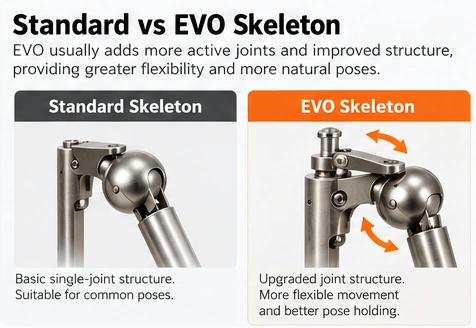
EVO skeletons typically improve the movement capabilities of a standard frame.
For example, Irontech Doll‘s EVO skeleton includes movable shoulders and double-gear knee joints. These changes provide more flexibility when adjusting the shoulders and bending the legs.
However, EVO features differ between brands. Two dolls labeled “EVO Skeleton” shouldn’t automatically be expected to have identical joints or movement capabilities.
EXP Skeleton
Some manufacturers offer further upgrades beyond their standard EVO designs.
For example, the ZELEX EXP skeleton includes a ball-joint neck, double-jointed elbows, and improvements to the shoulders, wrists, and waist.
These features may be useful if you want more control over head positioning, arm movements, or detailed photography poses.
Rather than choosing a skeleton based on its name, ask three questions: Which joints have been upgraded? What additional movements do they allow? And will you actually use those movements?
Tight vs. Loose Skeleton: Which Is Better for Everyday Use?
Besides different joint structures, some manufacturers offer multiple joint tightness options.
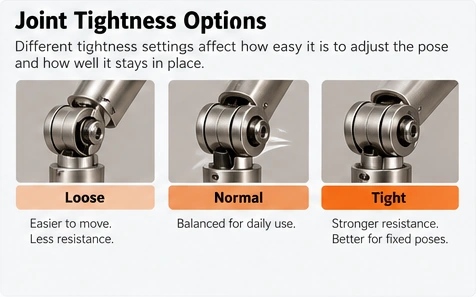
For example, Irontech Doll offers Normal Skeleton and Loose Skeleton configurations. The normal version provides greater joint resistance for maintaining poses, while the loose version is easier to move but doesn’t offer the same ability to hold certain positions.
| How You Plan to Use Your Doll | What to Look For |
|---|---|
| Frequently changing arm, leg, or sitting positions | Smooth movement and moderate joint resistance |
| Mostly lying down, with few fixed poses | Standard or suitable loose-joint configurations |
| Photography and carefully arranged poses | Stronger pose-holding ability |
| Frequently moving or repositioning a heavy doll | Manageable joint resistance and overall body weight |
| More natural shoulder and waist movements | Upgraded joints in those specific areas |
For first-time buyers without special posing requirements, standard joint tightness is often a sensible starting point.
If you mainly adjust your doll while she’s lying on a bed, lower-resistance joints may make positioning easier. If you want her arms or upper body to maintain a particular angle without support, joint resistance becomes more important.
Before choosing a loose-joint skeleton, ask whether it affects standing, sitting stability, or other movements. The term “Loose Skeleton” doesn’t mean exactly the same thing across manufacturers.
Does TPE or Silicone Affect Skeleton Flexibility?
Yes. The outer material can affect how far a finished doll can safely move, but that doesn’t mean one material always allows a greater range of motion than the other.
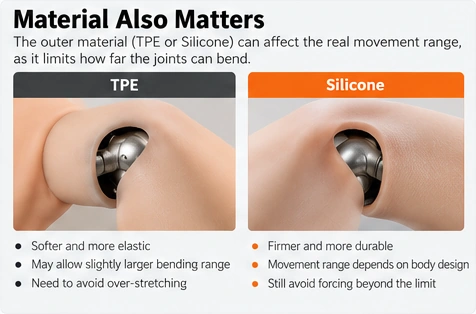
The skeleton determines the mechanical movement of each joint. The surrounding TPE or silicone adds physical resistance and may limit that movement.
For example, a knee joint may be capable of bending deeply, but the material around the thigh and calf becomes compressed as the leg folds. Larger movements at the shoulders and waist can also stretch the surrounding material.
TPE and silicone differ in softness, elasticity, recovery, and tear resistance. However, their actual behavior also depends on the specific formulation, material thickness, and body construction.
As a result, two dolls using the same skeleton may not have exactly the same movement capabilities.
For a closer comparison of their feel, care requirements, and long-term differences, read our TPE vs. Silicone Sex Dolls Guide.
Regardless of the material, never force a finished doll to reach the maximum angle shown in a bare-metal skeleton demonstration.
Finger Skeletons: Copper Wire vs. Articulated Fingers
Finger construction is easy to overlook. It doesn’t affect major body movements, but it makes a noticeable difference when arranging hand gestures, holding lightweight props, or taking photos.
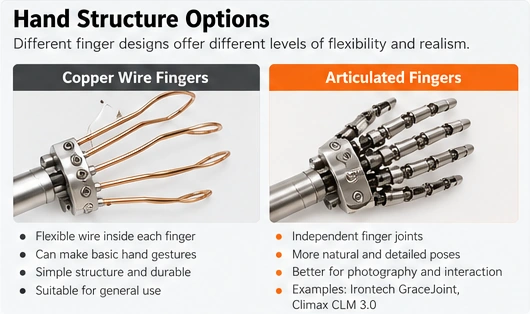
Two common designs are copper wire fingers and articulated finger joints.
Copper Wire Fingers
Traditional wire fingers use bendable metal wires inside each finger to change their shape. They don’t have independent mechanical finger joints.
This simple construction allows basic hand gestures and is generally sufficient for users who rarely change their doll’s finger positions.
However, repeated bending in the same area can cause metal fatigue over time. Avoid pulling directly on the fingertips or forcing the wires into sharp bends.
Articulated Fingers
Articulated fingers use segmented mechanical joints, allowing more precise adjustments to individual fingers.
They’re particularly useful for photography, creating detailed hand gestures, or positioning a doll’s hands naturally around lightweight objects.
Different manufacturers use different joint designs.
For example, Irontech Doll’s GraceJoint system uses multi-jointed fingers, an articulated thumb base, and anti-puncture features at the fingertips.
Another example is the Climax Doll CLM 3.0 Articulated Finger System. Used in certain ULW and Ultra silicone dolls, it features a reinforced finger structure, inward thumb movement, lateral wrist articulation, and improved hand-pose control.
CLM 3.0 is built into applicable models rather than being a universal optional upgrade available for every Climax Doll.
If your main priority is adjusting full-body poses, articulated fingers may not be an essential upgrade. But if you care about hand gestures and photography details, they’re worth comparing.
Neither copper wire nor articulated fingers should be used to support the doll’s body weight.
Are Standing Feet and Skeleton Weight Support the Same Thing?
No. They serve different purposes.
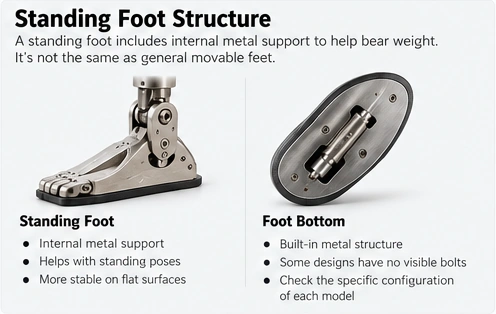
The skeleton supports the body and allows posture adjustments. Safe standing also depends on the foot structure, body weight, center of gravity, and external support.
Some dolls come with standing feet that use internal metal supports or bolts to reduce direct pressure on the soft soles. Certain models also offer reinforced feet without visible external bolts.
However, having standing feet doesn’t mean a doll can safely stand independently for long periods or be left standing unattended.
Heavier full-body dolls require additional care when balancing the body and managing the loads placed on the ankles, knees, and hips.
If you only want your doll to stand occasionally for photos, follow the manufacturer’s instructions and provide reliable support.
If she spends most of her time on a bed or sofa, standing feet may not be an upgrade worth prioritizing.
How Can You Tell Whether a Sex Doll Skeleton Is Durable?
It’s difficult to predict a skeleton’s exact lifespan before buying, but its construction and the manufacturer’s testing information can help you evaluate it.
Start by looking at the materials and connections.
For example, Irontech Doll states that some of its skeletons use 201 stainless steel, manganese steel alloy washers, and high-strength bolts. These details provide insight into how the joints are assembled and what components the manufacturer uses to manage mechanical wear.
Next, look for repeated movement tests.
Some manufacturers conduct bending-cycle, joint-resistance, or load-bearing tests. These results can be useful, but they need context. Laboratory test results don’t automatically represent the skeleton’s lifespan under everyday conditions.
Finally, ask how problems are handled.
Clear construction details, practical demonstrations, and after-sales support are more useful than vague claims such as “extremely strong” or “never loosens.”
How to Reduce Skeleton Wear During Everyday Use
Even a well-built skeleton can experience unnecessary stress from improper handling or storage.
When adjusting a heavier doll, place her on a stable surface first. Then move the arms, knees, or hips slowly and carefully.
Support the body when repositioning her. Avoid dragging the doll by her wrists, ankles, or head, and don’t suddenly twist joints that are already near their movement limits.
If a joint becomes unusually stiff, loose, or noisy, stop forcing it and contact the seller for guidance.
For long-term storage, keep the limbs in natural, relaxed positions. Avoid leaving the knees, fingers, or other joints at their maximum bending angles for extended periods.
Laying the doll flat with suitable body support is generally easier to manage than maintaining complicated poses for long periods.
Some models also support dedicated hanging systems, but you should always follow the manufacturer’s installation and weight-limit instructions.
Five Questions to Ask Before Buying a Sex Doll Skeleton
Even if you can’t inspect the doll in person, a few specific questions can help you understand what you’re getting.
- Which skeleton version does this doll use? Confirm the exact design and whether it’s available for your chosen body.
- Which joints are movable? Pay particular attention to the shoulders, waist, hips, and knees.
- What joint tightness options are available? If Normal and Loose versions are offered, ask how they differ in pose-holding ability.
- Are articulated fingers and standing feet included? Don’t assume an EVO skeleton upgrade automatically includes every additional feature.
- Can the seller provide a movement demonstration? Ideally, the video should show the complete doll being positioned and whether the pose holds after the person releases the joints.
These questions usually provide more useful answers than simply asking whether a doll has the manufacturer’s most advanced skeleton.
Frequently Asked Questions
Choose a Skeleton That Fits How You Use Your Doll
If you mainly want natural sitting and lying positions with basic arm and leg movement, start by looking at the stability and joint resistance of a standard skeleton.
If you enjoy adjusting the shoulders, waist, and legs into different poses, the additional flexibility of an upgraded skeleton may be worthwhile. If photography and detailed hand gestures matter to you, articulated fingers and improved wrist movement deserve closer attention.
When comparing skeletons, focus on three practical questions: Do the poses look natural? Are the joints easy to adjust? And can the doll hold the intended position?
Long-term joint performance matters just as much. The best skeleton isn’t necessarily the one that offers the most poses. It’s the one that makes your preferred movements easier while providing appropriate support and reliable performance over time.








 WM Doll